Solar + Storage Buying Guide
Most Efficient Solar + Battery Systems in 2026: How to Balance PV Efficiency, Battery Capacity and Commercial ROI
Key Takeaways

The most efficient solar battery system is not automatically the one with the highest panel-efficiency figure. A useful system must match the available installation area, electricity-load pattern, battery capacity, inverter power, control strategy and site constraints. A high-efficiency module can be valuable on a small roof, while a commercial project may gain more from fewer high-wattage modules, appropriate storage power and a realistic operating schedule.
For a residential project, the practical question is usually how much solar energy can be used after sunset and which household circuits need backup. For a factory, commercial building or EV charging site, the question is more often how the system can reduce demand peaks, support critical loads and work with the local tariff and grid connection. These are different decisions, even when both projects use solar panels and batteries.
What “Most Efficient” Means in a Solar + Storage System
Solar panel efficiency describes the share of incoming sunlight that a module can convert into electrical power under stated test conditions. Wattage is the module's rated power under those same conditions. They are related, but they are not interchangeable: a larger module can have a higher wattage even when its efficiency is lower than a smaller module.
Once storage is added, system efficiency becomes broader than the PV module. The solar inverter, battery charge and discharge path, cable losses, operating temperature, shading, load timing and energy-management settings all affect the energy that is useful at the point of consumption. That is why a good proposal should explain both component ratings and the operating plan behind them.
Solar Panel Efficiency vs Wattage: Which Matters More?
Efficiency matters most when the installation footprint is constrained. A villa roof with obstructions, a small commercial roof and a carport with limited mounting area all have a physical ceiling on installed PV capacity. In these cases, generating more power from each square metre can help the designer make better use of the available surface.
Wattage can matter more when area is plentiful and balance-of-system work is a major cost. Fewer modules may mean fewer clamps, electrical connections, string-management steps and lifting operations. That does not make the largest available module the right answer; module dimensions, roof loading, handling conditions and replacement availability still need to be checked.
| Project condition | First question to ask | Typical priority | What to compare |
|---|---|---|---|
| Space-constrained home roof | How much PV fits safely? | Module efficiency | W/m², shading layout, inverter window |
| Commercial rooftop | Is output or installed cost the main constraint? | Balanced | W/m², W/module, mounting and labour |
| Ground-mount or large site | Can module count and construction cost be reduced? | Wattage and total cost | Module size, logistics, strings, BOS cost |
| Solar with backup | Which loads must run after sunset? | Storage fit | Battery kWh, inverter kW, backup panel |
| Demand-management project | When do peaks occur? | Storage power and controls | Interval data, kW, kWh, EMS strategy |
Why Battery Capacity and Inverter Power Must Be Evaluated Together
Battery capacity, stated in kWh, tells you how much energy can be stored. Inverter power, stated in kW, describes how much power can be supplied or converted at one time within the equipment limits. A system with adequate kWh but insufficient kW may not support several large loads running together. Conversely, a high-power inverter paired with too little usable storage may meet a short surge but not the desired backup duration.
Before requesting a solar battery system quotation, separate continuous loads from starting or surge loads. Air conditioners, pumps, refrigeration equipment and some industrial machinery may need different planning treatment from lighting, communications equipment or ordinary plug loads. Equipment documentation and a qualified electrical design review are essential before selecting final cable, protection or switching arrangements.
For households, YINEN POWER's home battery energy storage range is designed around LiFePO₄ battery options, hybrid inverter integration and multiple installation formats. The right capacity still depends on the actual household load, the circuits selected for backup, solar production, local tariffs and the desired autonomy period.
Build the System Around the Load Profile, Not a Headline Rating

The same battery size can deliver very different value at two sites. A home that consumes most of its energy in the evening may use a battery mainly to shift daytime solar generation into the night. A small business with a sharp afternoon demand peak may need a different configuration, where battery discharge is scheduled around that peak rather than around overnight backup.
For example, an illustrative facilities manager at a small workshop might see that the monthly electricity bill is driven by a short interval when HVAC, compressors and charging equipment overlap. Installing more solar modules alone may not address that interval if production is low at the same time. Load data can reveal whether the better next step is changing the operating schedule, allocating battery power to the peak or combining both measures.
Use this pre-quotation checklist to make the discussion more productive:
- Collect at least several representative electricity bills and, where available, interval-load data.
- Mark critical loads, noncritical loads and loads with high starting demand.
- Record usable roof or ground area, orientation, obstructions and likely shading periods.
- Identify the grid connection, phase arrangement, local tariff periods and export rules.
- Define the goal: bill management, backup, solar self-consumption, demand management, off-grid operation or future expansion.
- Confirm whether indoor, outdoor, cabinet or container installation is appropriate for the site.
Residential Solar + Storage: Prioritize Usable Energy and Backup Design

For a residence, a highly efficient solar battery system should first support the way the household actually lives. A family that is away during daylight hours may place more value on evening self-consumption. A home in an outage-prone area may prioritize selected backup circuits, transfer performance and the ability to operate essential appliances without trying to run every load.
The battery should not be sized from average consumption alone. Review the time of use, essential loads, expected backup hours, battery operating limits, inverter capability and the PV array's seasonal production. This avoids a common mismatch: selecting a large battery based on a monthly bill but overlooking the real-time power required by appliances that run together.
LiFePO₄ batteries are widely used in residential energy storage because they are commonly selected for their stability and long-cycle application potential. The final system should nevertheless follow the battery and inverter documentation, the installation environment and local electrical and safety requirements.
Commercial and Industrial Projects: Prioritize Operating Strategy
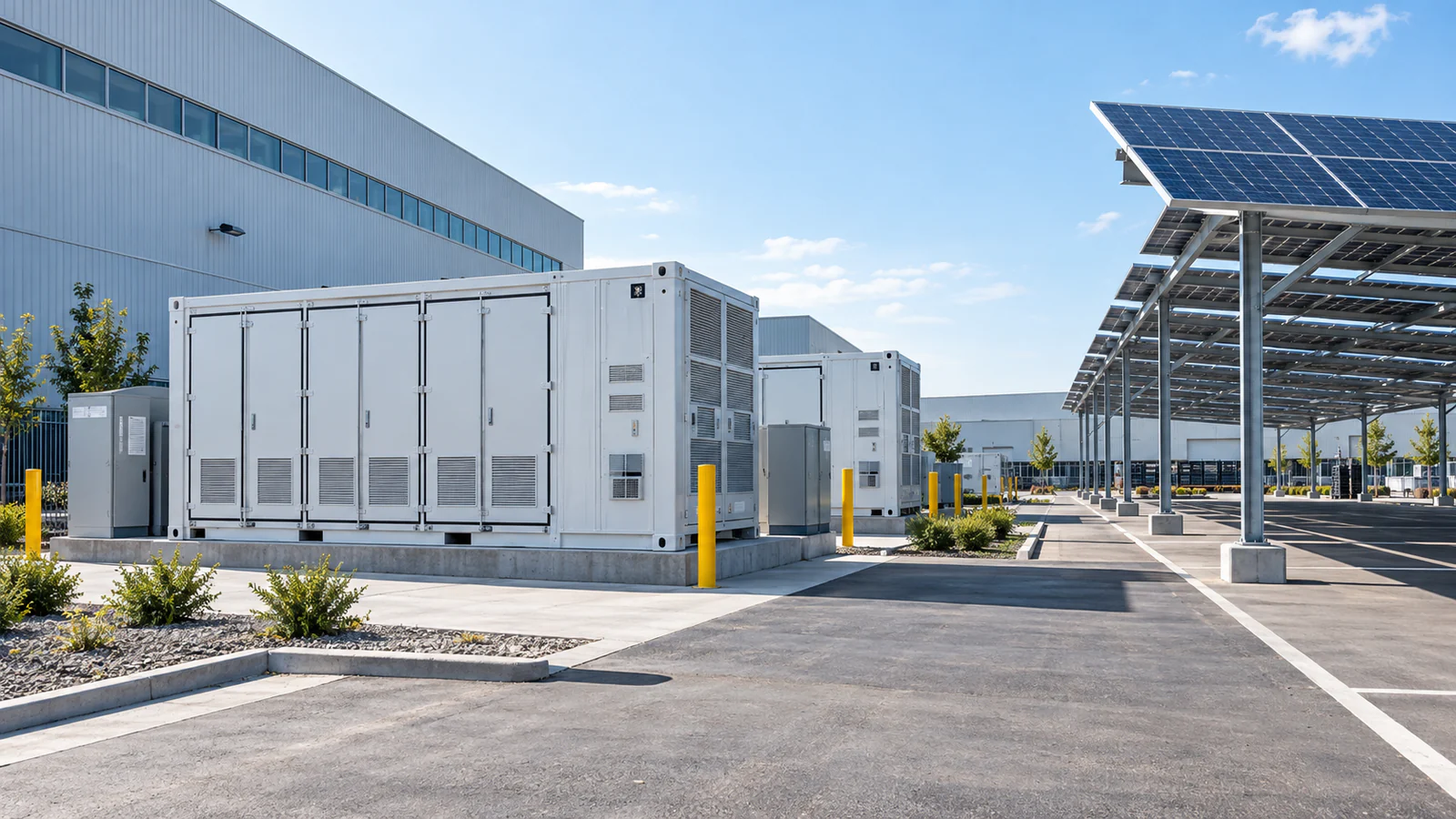
For commercial and industrial sites, the most efficient solar battery system is often the one that performs the intended duty consistently—not the one with the highest individual component rating. A solar-plus-storage project can be designed for peak shaving, demand management, solar energy utilization, critical-load backup or a mix of these objectives. Each requires different inputs and controls.
YINEN POWER's commercial and industrial energy storage solutions include energy-storage cabinets, battery energy storage systems and solar-plus-storage configurations. The commercial page describes applications including factories, industrial parks, shopping centres and EV charging stations, as well as cabinet and container options selected according to project scale and site conditions.
An EPC team should check the interval-load profile, contracted capacity, peak-demand periods, transformer and switchgear constraints, PV production curve, desired backup duration and available installation space. The proposal should also state the boundaries: equipment selection does not replace utility approvals, protection coordination, fire-safety planning or the electrical work required by the applicable rules.
Real-World Factors That Affect Solar + Storage Performance
Component data sheets are important, but a field system also depends on conditions that are easy to overlook during a quick comparison. Reviewing these issues before procurement is usually more valuable than chasing a small difference in a headline efficiency rating.
Temperature and Ventilation
PV modules and power electronics operate differently as temperatures rise. Roof clearance, ventilation, installation location and enclosure design can affect operating conditions. For batteries and inverters, the allowed ambient range and thermal-management approach should be reviewed from the applicable product documentation rather than assumed from a typical design.
Shading, Soiling and Layout
Chimneys, parapets, nearby buildings, trees and seasonal changes can reduce solar production. Dust and local pollution can also affect yield. A shade survey, sensible string design and a realistic cleaning plan may improve actual production more than a marginal change in module nameplate efficiency.
Charge and Discharge Timing
The battery only adds value when it is charged and discharged at useful times. An energy-management setting should reflect the project goal: preserve reserve energy for backup, charge from solar first, respond to time-of-use tariffs or reduce demand peaks. These priorities can conflict, so they should be agreed before commissioning.
Expansion and Service Access
A project expected to grow needs physical room, electrical allowance and control compatibility for future equipment. Modular solutions can help, but expansion should be planned around the full system rather than treated as a guaranteed simple addition. Service clearances, transport access and local maintenance capability belong in the early design review.
When Higher-Efficiency PV Modules Make Sense—and When They Do Not
Choose higher module efficiency when the design is genuinely limited by usable area and each additional square metre of production has measurable value. This is common on compact residential roofs and commercial roofs with multiple obstructions. The decision should still consider price, mechanical layout, shading and compatibility with the inverter and mounting system.
Do not let efficiency become a shortcut for overall system value. On a larger site, a lower cost per installed watt, manageable module handling, suitable storage power and a strong operating strategy can have more influence on the project result. The best choice is therefore project-specific rather than a universal product ranking.
Commercial Buying Checklist: Questions to Ask Before You Order
| Topic | Questions for the project team |
|---|---|
| PV array | What area is usable, what shading occurs and which module size can be installed safely? |
| Load profile | What are the daily, seasonal and peak-demand patterns? |
| Battery | How many kWh are needed, what reserve is required and what operating limits apply? |
| Inverter and PCS | What continuous power, surge capability, phase arrangement and grid function are needed? |
| Controls | Is the goal solar self-consumption, backup, tariff shifting, demand management or several of these? |
| Site | What are the indoor/outdoor conditions, access limits, ventilation needs and expansion constraints? |
| Compliance | Which utility, electrical, fire and local permitting requirements apply? |
| Commercial terms | What is included in the scope, commissioning support, documentation, exclusions and warranty conditions? |
Frequently Asked Questions
Is the most efficient solar battery system always the most expensive one?
Not necessarily. Higher-efficiency modules or premium equipment can raise the initial cost, but their value depends on roof area, energy price, system design and the operating objective. Compare total installed cost and expected operation, not just a single component price.
Should I choose battery kWh or inverter kW first?
Start by identifying both the energy requirement and the power requirement. kWh is central to backup duration and energy shifting; kW is central to how many loads can operate at the same time. A qualified designer should assess the full load profile and equipment documentation together.
Can a commercial battery reduce a demand peak?
It can be configured for demand-management applications when the site load, tariff structure, interconnection limits and control strategy support that use. The expected result should be modelled using real interval data, not estimated from a single monthly bill.
What information should I send for a YINEN quotation?
Send your location, electricity bills or interval data, PV capacity or proposed installation area, load type, peak power, desired backup duration, installation conditions and project goal. These inputs help YINEN POWER start a more relevant system discussion.
Plan a More Efficient Solar + Storage System with YINEN POWER
The most efficient solar battery system is the one that fits your site, your loads and the way you plan to operate it. Begin with the available solar area and measured electricity demand, then match PV capacity, battery energy, inverter power and controls to the intended outcome. For residential and commercial projects alike, early load analysis reduces the risk of selecting equipment that looks strong on paper but does not address the real operating need.
Contact YINEN POWER with your project information to discuss a solar-plus-storage configuration for your home, business or industrial site.
Plan Your Solar + Storage System with YINEN POWER
Share your load profile, installation conditions, solar plan and project target. Our team can discuss a suitable residential or commercial energy-storage direction with you.
Get a Quick Quote