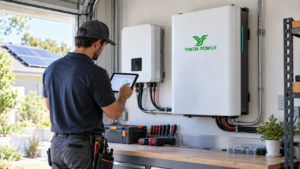
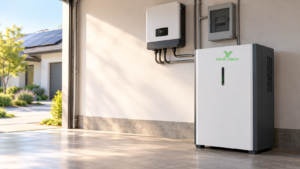
A solar battery warranty is more useful when you can explain what it covers, when it starts, which operating conditions apply, and what evidence will be needed if a fault is reported. This guide helps buyers, installers, EPCs and distributors prepare for battery warranty registration and evaluate energy storage warranty terms before a project is commissioned.
For a neutral procurement framework, consult the U.S. Department of Energy battery energy storage system procurement checklist alongside the current model-specific documents.

Why a Solar Battery Warranty Needs More Than a Headline Term
A headline warranty period does not answer every practical question. An energy storage warranty may contain separate provisions for defects in materials or workmanship, retained usable energy, cycle use or cumulative energy throughput. It can also define a start date differently from the date equipment is received. The meaningful comparison is whether the document matches the actual model, market and intended operating profile.
Before comparing offers, request the current warranty document alongside the product datasheet and installation manual. Verify the document revision, model name, applicable region, supplying route and any registration requirement. This helps prevent a project from being assessed against information intended for another product version or destination market. Use a solar battery warranty checklist to confirm the model, document revision and market before equipment is ordered.
Confirm the Exact Product, Region and Warranty Start Date
Energy storage warranty terms are normally tied to a defined product and territory. A project file should connect the battery serial number, inverter or system configuration, installation location, purchase source and commissioning record. This information is equally useful for distributors that manage stock and documents across several markets.
The warranty start date deserves the same attention as the end date. Depending on the applicable document, it may be related to installation, commissioning, shipment or another defined event. Do not assume that storage time or a delayed handover will be treated the same way in every policy. Ask the supplying party to identify the applicable rule for the proposed model in writing.
Understand Product Warranty and Battery Performance Terms
A product-defect warranty and a battery-performance commitment are not identical. The first normally concerns defects under the applicable conditions. A performance provision may instead be connected to retained energy, cycle count, cumulative throughput or a defined test method. Both can matter, but they should be compared as separate parts of the warranty document.
| Question to ask | Why it matters |
|---|---|
| Which exact model and document revision apply? | Similar product names can still carry different regional or generation-specific terms. |
| Does the document distinguish defect coverage from energy-retention coverage? | This clarifies whether a reported issue is a fault question, a performance question, or both. |
| What operating conditions define the performance threshold? | Temperature, current, state of charge and measurement method can affect evaluation. |
| Is there a cycle or throughput condition? | Time and accumulated use may work together, so project duty cycle matters. |
| What remedy and service route are described? | Assessment, repair, replacement and remaining-coverage handling should be clear before purchase. |
For a useful comparison, connect these questions to the actual system design: battery quantity, inverter power, expected load profile, charging source, environment and operating strategy. Final electrical design, protection, wiring and commissioning must be confirmed by qualified professionals under local requirements.
Register the System While Records Are Easy to Collect
Warranty registration is easiest at handover, when labels, invoices, installation details and commissioning evidence are available. Waiting until a fault occurs can make it harder to locate serial numbers, prove the purchase route or reconstruct the original configuration.
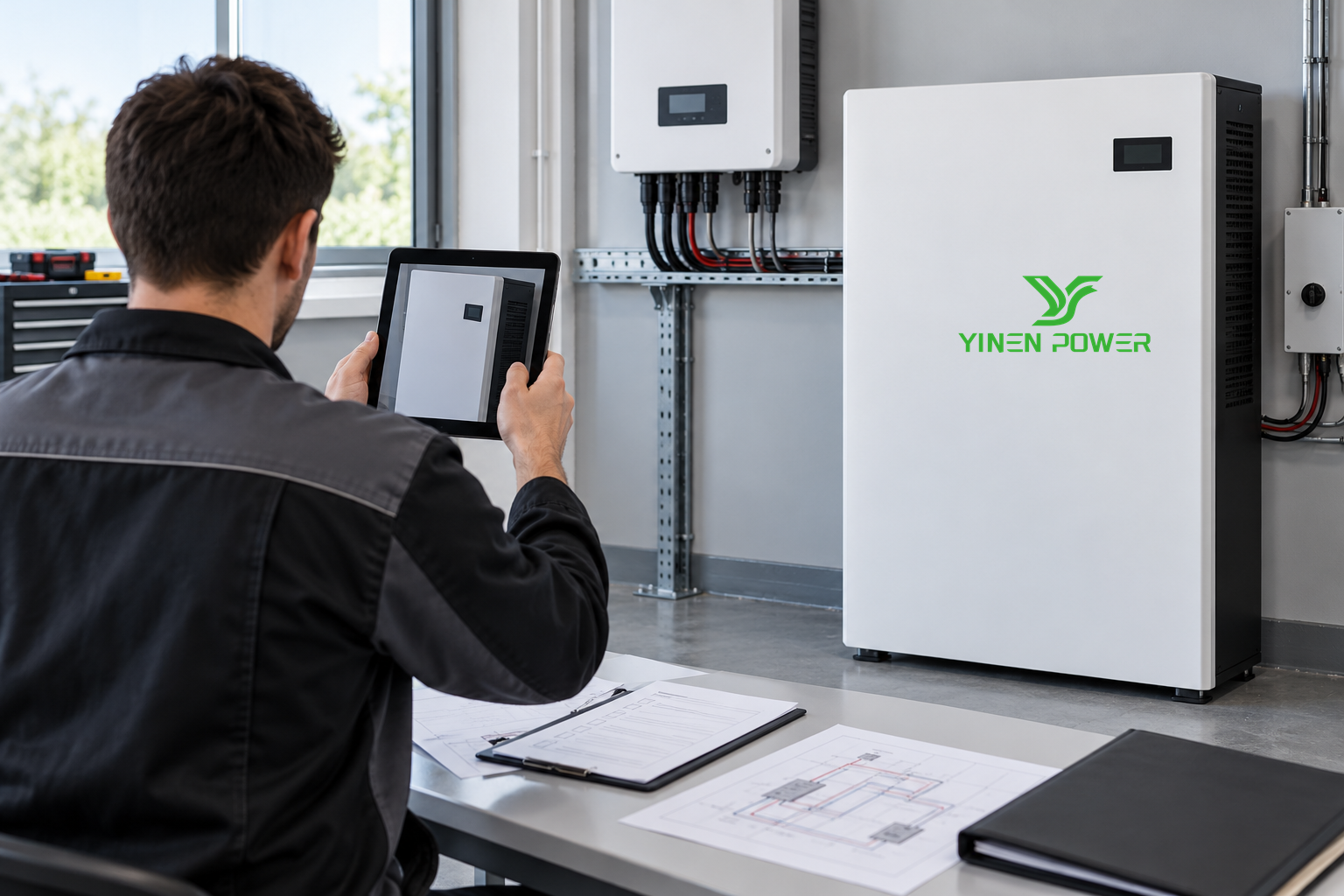
Registration file checklist
- Purchase record and supplying company details
- Battery model, serial number and applicable document version
- Inverter or PCS model, communication arrangement and topology
- Installation address, commissioning date and installer contact
- Commissioning record, equipment-label photographs and any registration confirmation
- Current installation manual, user guidance and service contact for the destination market
For residential planning, use the same records to confirm the battery and inverter direction against loads, backup expectations and installation conditions. Explore YINEN POWER home energy solutions for an early discussion framework; final product selection must follow the applicable documents and local installation requirements.
Keep Operating Conditions Within the Approved System Design
Battery operating conditions are part of warranty readiness, not just a maintenance detail. Installation environment, ventilation, compatible equipment, wiring, system settings and communication configuration can all affect safe operation and the ability to diagnose an issue. A connector that physically fits is not evidence that a battery and inverter are approved to work together.
Installers and EPCs should preserve commissioning settings and error history in the project file. Do not open a battery pack, bypass protection functions or use unapproved repair methods to solve a fault. When a system shows a repeated alarm, unusual temperature, unexpected shutdown or abnormal capacity behaviour, record the event and follow the authorized service route.
Prepare a Clear Solar Battery Warranty Claim
A complete solar battery warranty claim helps technical teams distinguish a possible battery issue from an inverter, wiring, communication, protection-device or site-condition issue. Exact evidence requirements vary, but a clear report is easier to assess than a brief statement that the battery is not working.

Information to prepare before contacting support
- Battery and supporting-equipment model and serial numbers
- Date, time and description of the observed issue
- Photographs or screenshots of indicators, alarms and error codes
- Operating logs or monitoring records, where available
- Current inverter, PV and load configuration details
- Installation, commissioning and purchase records
Do not erase logs or repeatedly reset the system before the service team reviews the evidence unless an authorized safety instruction requires it. If there is smoke, swelling, liquid leakage, severe heat, damaged wiring or another immediate safety concern, isolate the system only when it is safe to do so and contact qualified local professionals and the authorized service route.
Review Exclusions and Service Boundaries Before Purchase
Every warranty document has boundaries. Typical areas to examine include installation outside the approved region, incompatible equipment, unauthorized modification or repair, incorrect transport or storage, physical damage, missing serial-number evidence, operation outside documented conditions and late reporting. The exact scope must come from the warranty for the selected product, not from a general online summary.
Procurement teams should ask who receives the first report, who performs diagnosis, which documents are needed, how a service decision is documented and how any repair or replacement affects remaining coverage. This turns after-sales support from a generic phrase into a project-ready service path. A solar battery warranty file is easier to review when the records are arranged before a fault is reported.
Compare Warranty Readiness Across Suppliers
A reliable comparison combines written terms with evidence you can maintain. Your project file should make it easy to match battery serial number, purchase route, installation record, compatible system components and operating history. A supplier that identifies the correct document and service contact for your market makes the process clearer. This solar battery warranty preparation also supports faster, evidence-based project discussions.
For distribution, installation, EPC and OEM discussions, review the YINEN POWER energy storage partner program. Share your country, application, battery and inverter direction, project timeline and document requirements so the discussion starts with the correct product scope rather than a generic warranty statement.
Frequently Asked Questions
Does a battery warranty mean capacity will never decline?
No. Lithium battery performance changes with time and use. Where a warranty contains a performance condition, read the stated test method, threshold, operating conditions and any throughput or cycle condition. A headline term is not a promise of unchanged capacity.
Can any battery be combined with any inverter?
No. Nominal voltage, current limits, control and communication protocol, charge settings, protection logic and approved compatibility must be checked. Confirm the selected combination through current product documentation and the supplier support route.
What is the first step when a battery fault is suspected?
Prioritize safety, preserve error information and contact the authorized service route with model, serial number, records and a clear description of the issue. Do not disassemble or force-charge a battery pack.
Send YINEN POWER your country, system direction, target model and required project documents.