Is a solar pump right for your farm? If most water is needed during the day, grid power is unreliable or unavailable, and you can store water, solar pumping is worth assessing. If the pump must run after dark or several motors start together, the backup supply, inverter, and battery need a separate design review.
This guide shows how to size a solar water pumping system from water demand and total dynamic head, compare water and electrical storage, and request quotations based on the same site conditions. Final pump and electrical choices require the relevant equipment data and a site-specific design.
When does a solar pump make sense?
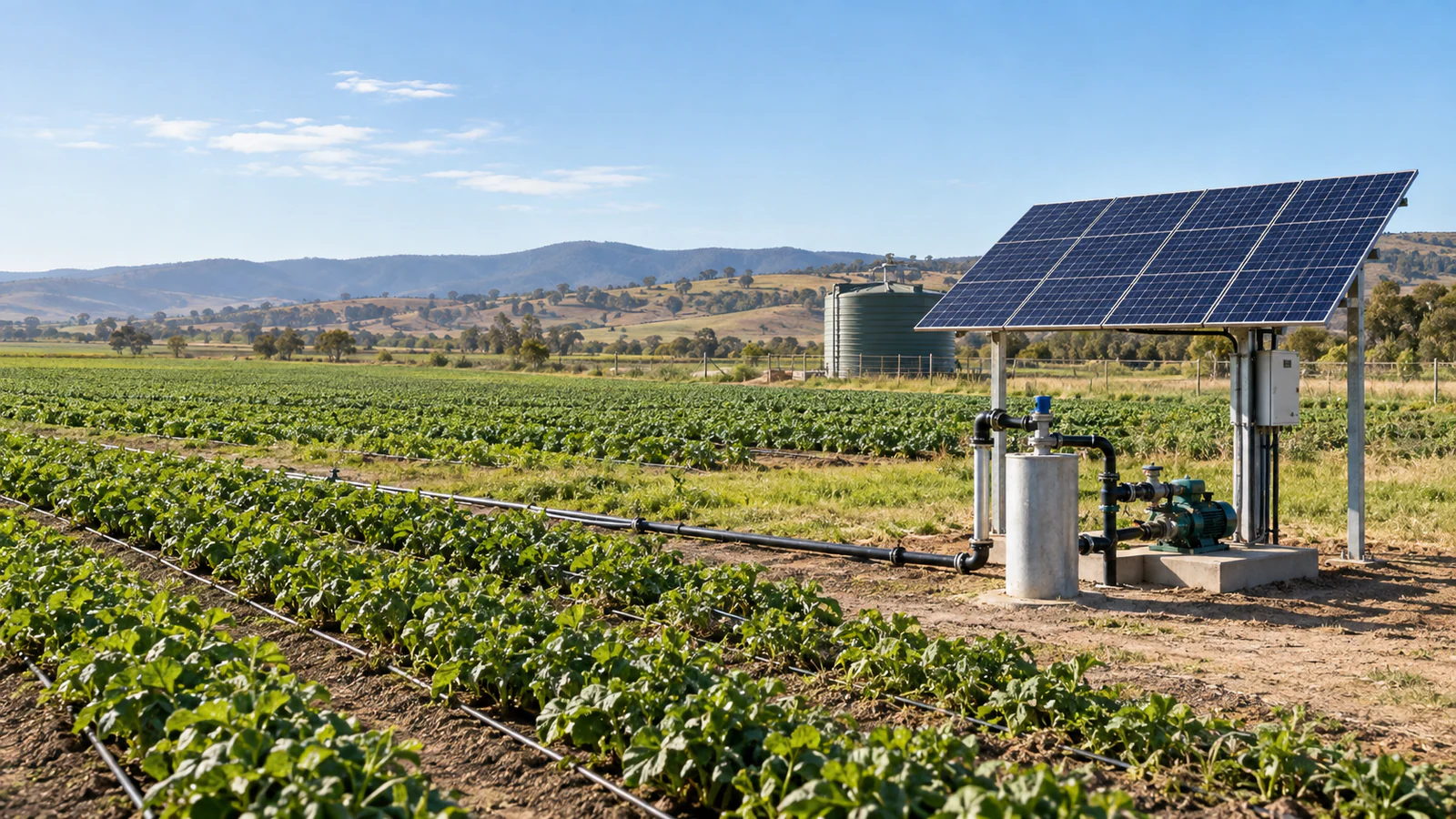
A solar pump can serve surface-water irrigation, livestock watering, remote farm supply, or tank filling. Its suitability depends on the available water source and permitted withdrawal, delivery route, required pressure, and solar resource during the month when demand is hardest to meet. A sunny annual average cannot answer that question by itself.
First separate “we need water at night” from “the motor must run at night.” Daytime pumping into a properly sized tank may address the first need. The second may call for a grid connection, generator, or engineered battery system. A tank alone may not provide the pressure required for nighttime sprinkler irrigation.
How does a solar pump system work?
A solar pump system typically combines a PV array, motor and pump, compatible control or power-conversion equipment, piping, and a delivery point. A DC pump and an existing AC pump can require different controllers, inverters, and voltage arrangements. A tank, battery, grid connection, or generator is selected to meet the required supply schedule.
A submersible pump operates in the water source and is often considered for wells. A surface pump sits outside the source where suction and site conditions allow it. Neither should be chosen by rated watts alone: the pump curve must deliver the required flow at the actual total dynamic head, with water level and maintenance access checked.
PV output varies with sunlight, so the control equipment must suit the pump motor's electrical requirements. Maximum power point tracking can help a compatible system use changing solar output; it cannot guarantee constant flow on a cloudy day. Compatibility between a particular pump and a YINEN POWER inverter or storage product must be checked by model, phase, starting method, and interface.
What are the benefits and limits of solar pumping?
At a remote site, a solar pump may reduce purchased electricity or fuel use and avoid some grid extension costs. If demand overlaps with daylight, pumping can also reduce the amount of electrical storage needed. Savings still depend on local tariffs, fuel delivery, civil work, and maintenance; solar pumping does not have zero operating cost.
Cloud cover and seasonal changes affect pumping hours and delivered volume. A well's sustainable yield may be lower than a pump's nameplate flow. PV cleaning, filters, leaks, electrical protection, and water-source management remain part of operation. For essential supply, specify the minimum acceptable daily delivery and a backup plan.
Consider a farm manager who fills an elevated tank during daylight and supplies lower livestock troughs by gravity at night. That can work when tank volume, elevation, and pipe pressure have been verified. It does not automatically meet a separate requirement to run high-pressure sprinklers after sunset.
How do you size a solar pump?
Start with the daily water volume needed in the critical month. Then determine the total dynamic head from the operating water level to the delivery point. Head includes elevation change, pipe friction, and any pressure required at the outlet. Well depth or horizontal pipe length on its own is not a substitute for this calculation.
- Define peak water demand. Record the daily volume and timing for irrigation zones, livestock, or other outlets. Do not substitute the annual average for the most demanding period.
- Measure source and pipe conditions. Obtain static and pumping water levels, sustainable source yield, elevation difference, pipe diameter and length, and required outlet pressure.
- Check the pumping window. Use local solar data for the critical month and compare daily demand with output from the pump curve at the calculated head.
- Check electrical fit. Record the motor nameplate, phase, voltage, running and starting current, control method, and compatibility of the proposed PV, inverter, and backup supply.
For an arithmetic illustration, a peak demand of 24 m³/day delivered during a six-hour effective pumping window calls for an average 4 m³/h. That division does not select the pump or PV array. The pump must produce the flow at the actual head, and the designer must examine changing hourly sunlight and any tank buffer.
The FAO's solar pumping guidance describes sizing around the critical relationship between water demand and available solar energy. For irrigation, the highest-demand month need not be the least sunny. A more constant supply obligation can make the least sunny month more important. Ask for monthly supply and demand results, not only clear-sky rated flow.
Water storage, battery storage, or backup power?
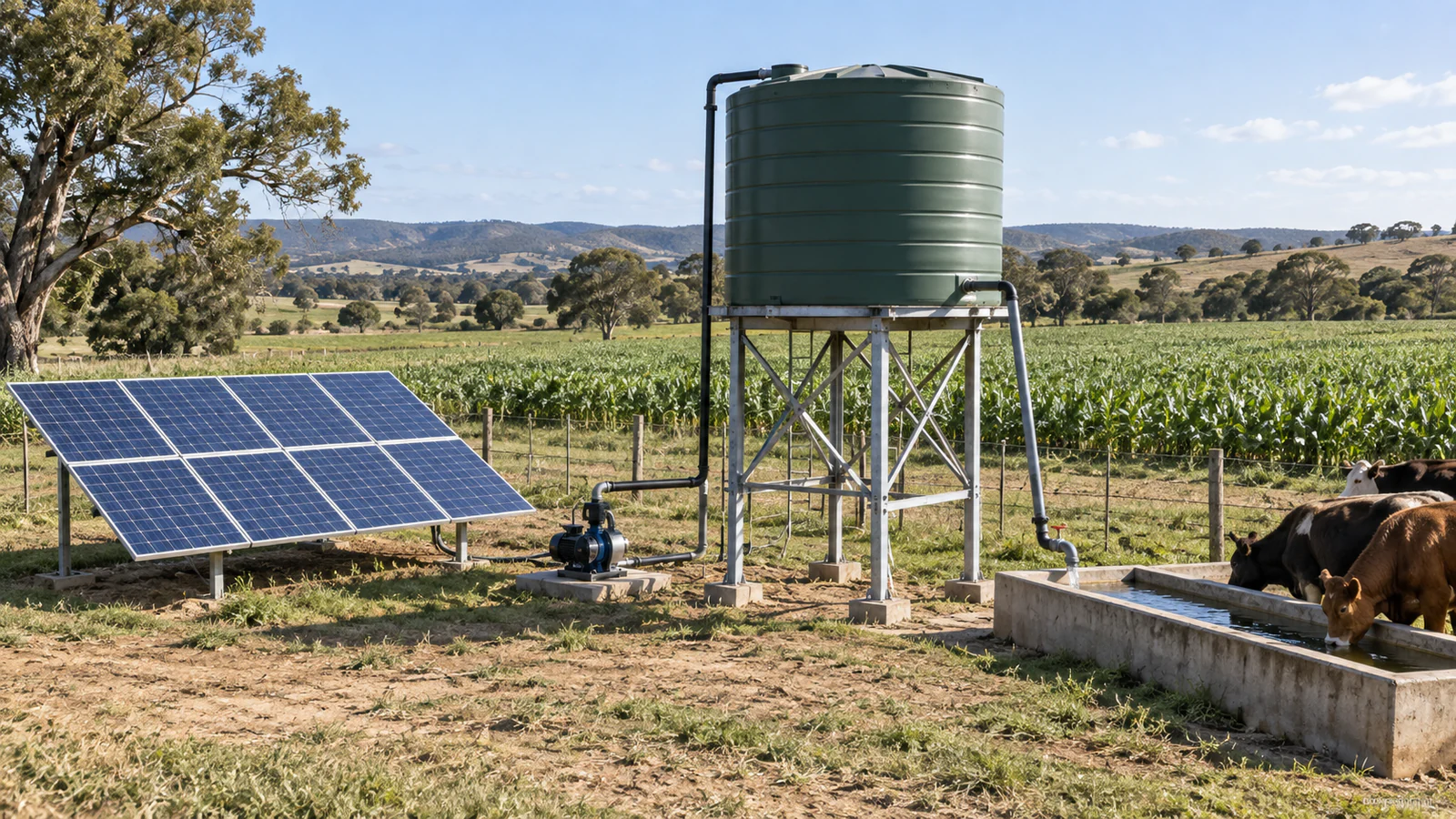
Ask whether the site needs water available after sunset or the pump motor itself to run then. Where daytime pumping is possible and a suitable tank or reservoir can be built, compare water storage first. Tank design still depends on water quality, structure, evaporation, terrain, and the pressure needed for distribution.
| Configuration | Best fit to investigate | Key constraints and cost drivers |
|---|---|---|
| Direct solar pumping plus water storage | Concentrated daytime pumping; water supplied later from storage | Tank, foundation, pipework, water quality, and delivery pressure |
| Solar plus battery | Pump or other critical electrical loads must run without sunlight | Motor starting power, battery discharge capability, runtime, temperature, and replacement |
| Solar plus grid or generator | Existing connection or defined backup pumping periods | Switching, tariffs or fuel, control compatibility, and electrical protection |
Battery capacity in kWh describes only part of the electrical requirement. It does not prove that a pump will start. Check continuous and surge output from the inverter, allowable battery discharge power, and the motor's actual starting method. If refrigeration or ventilation shares the supply, calculate a realistic simultaneous-load case.
Water storage is often a practical way to cover water demand outside sunny hours, as explained in solar irrigation storage guidance. The better choice depends on what must keep operating, the site's hydraulic design, and the full installed cost.
What determines solar pump system cost?
There is no reliable worldwide price for a solar pump system with a given motor rating. The quotation can include the pump and motor, PV array, controller or inverter, mounting, cable, piping, water storage, installation, and optional battery. Retrofitting an AC pump can also require distribution changes, protection, or motor replacement.
Compare offers against identical daily water delivery, head, backup duration, and evaluation period. Request separate installed-equipment costs, electricity or fuel costs, maintenance, and expected replacement items. A low initial price that excludes pipe losses or a tank may not deliver the same service. Calculate payback only with local cost and performance assumptions.
What information should you send with a quotation request?
A common site brief makes solar pump proposals easier to compare. If pumping water level, outlet pressure, or motor starting data are missing, ask the designer to identify assumptions and the measurements needed before final selection. A modeled output should not be presented as a guaranteed field result.
- Project location, use, peak daily water volume, hourly or daily demand pattern, and possible expansion.
- Source type, well diameter and water levels, sustainable yield, inlet and outlet elevations, pipe length and diameter.
- Existing pump nameplate and curve, control method, phase, voltage, and starting details.
- PV mounting space and shade, available grid or generator, tank options, and required backup duration.
Solar pump FAQs
Can a solar pump run at night?
A pump powered only by real-time PV generation cannot pump after sunset. If you only need water at night, assess daytime pumping and water storage. If the motor must run, size a battery, grid, or generator arrangement for its operating period and starting as well as running power.
Can I run an existing AC water pump on solar power?
Possibly, but an existing AC pump cannot simply be connected to PV modules. Verify motor phase, voltage, frequency, starting behavior, and pump curve before choosing compatible conversion and control equipment. Compare the retrofit with a replacement pump and other backup arrangements.
What happens on cloudy days? Does every system need a battery?
Flow can fall or stop as irradiance changes, depending on the controller and pump operating point. A battery is not mandatory for every solar pump. If a tank, adjusted delivery schedule, or existing grid connection meets the service requirement, compare those options before adding electrical storage for nighttime motor operation.
Plan farm pumping power with YINEN POWER
A workable solar pump design starts with water volume, total dynamic head, and supply during the critical month. Only then should the PV, controls, water storage, and backup supply be selected. YINEN POWER's farm energy storage solutions cover PV, inverter, and storage directions for agricultural loads; the fit of a particular product to a pump requires a technical compatibility check.
For a farm pumping project, send your site location, daily demand, head measurements, pump motor nameplate, operating schedule, and backup target. YINEN POWER can discuss relevant PV, inverter, and battery configurations and identify the site conditions that still need verification.
Send your pump nameplate, water demand, head and backup target for a PV, inverter and storage discussion.
Get a Quick Quote