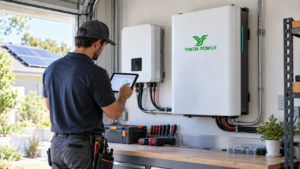
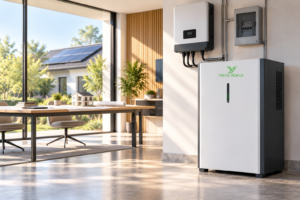
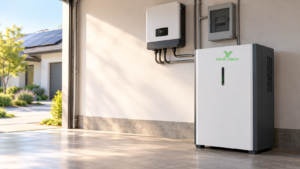
A 1MWh battery runtime estimate starts with one megawatt-hour of stored energy, but it does not deliver one fixed runtime for every commercial site. Runtime depends on the power your facility draws, the usable operating window, the controls, and the equipment included in the final system boundary.
For a factory, warehouse, commercial building or microgrid project, the most useful starting point is not “How many hours will 1MWh last?” It is “Which loads must be supported, at what power, and for which operating purpose?”

What Does a 1MWh Battery System Mean?
One megawatt-hour equals 1,000 kilowatt-hours of stored energy. In practical commercial storage planning, that capacity must be considered alongside the power-conversion system, protection equipment, control strategy, site loads and installation conditions. Capacity and power are related, but they are not interchangeable.
Use Load Power to Estimate a Starting Runtime
A simple planning relationship is usable energy divided by average load power. For example, if a facility planned to support a 250 kW load and the final usable-energy assumptions supported that duty, the starting calculation would indicate roughly four hours before accounting for project-specific operating limits. It is an estimate, not a performance guarantee.
| Average facility load | Illustrative energy-to-power relationship | What still needs validation |
|---|---|---|
| High power demand | Stored energy is used over a shorter window | PCS rating, load peaks and switching strategy |
| Moderate sustained load | Stored energy can support a longer planned window | Usable capacity, controls and recharge opportunity |
| Priority-load backup | Runtime can be extended by limiting supported circuits | Critical-load panel and outage operating plan |
Why Actual 1MWh Battery Runtime Changes by Project
Two sites with the same nominal capacity can have very different outcomes. Load shape, peak demand, charge and discharge rules, ambient conditions, auxiliary consumption, state-of-charge reserve and the required operating mode all affect the usable result.
- Peak shaving may call for short, high-power discharge periods.
- Solar shifting may depend on the available PV generation and tariff schedule.
- Backup planning depends on which circuits are prioritized during an interruption.
- Microgrid operation requires a coordinated design for generation, storage and controls.
Common Commercial Uses for 1MWh-Scale Storage
Commercial storage can be considered for demand management, later use of on-site solar, selected-load backup and coordinated energy planning. The business case should be built from site data and electricity-use patterns rather than a generic runtime claim.
YINEN POWER provides commercial energy-storage directions for distributed energy projects. Explore the liquid-cooled commercial and industrial energy storage cabinet and confirm the appropriate configuration against the project’s electrical and installation requirements.
For broader market context, the IEA battery storage report discusses the role of storage across power-sector applications. It is background reading only; your project’s runtime and commercial case still need to be calculated from site-specific data.
Air-Cooled, Liquid-Cooled or Containerized?
The right architecture depends on footprint, operating environment, cycling plan, maintenance access and delivery requirements. Cooling approach and enclosure format should be selected only after the project team defines the required energy, power and deployment conditions.
Seven Inputs for a Comparable 1MWh Storage Quote
- Interval load data and expected peak demand.
- Required power and intended discharge duration.
- Priority loads and backup sequence.
- Solar generation profile, if applicable.
- Site location, available space and installation environment.
- Grid interface and local compliance requirements.
- Included equipment, commissioning and service responsibilities.
Plan the Runtime Around the Job
A 1MWh battery system can be a meaningful commercial planning direction when capacity, power and controls are designed around a real operating objective. Ask suppliers to state the system boundary and assumptions clearly so proposals can be compared fairly.
Need a commercial energy-storage discussion? Contact YINEN POWER with your load data, solar plan and project objectives.