The lifespan of lithium ion solar batteries is not defined by one predictable failure date. Usable capacity normally declines gradually as the battery cycles and ages. A broad planning reference of around 10 to 15 years is often discussed for lithium-ion solar storage, but actual service life depends on the battery, the system and its operating conditions.
The real lifespan of lithium ion solar batteries depends on chemistry, cell quality, cycle frequency, depth of discharge, temperature, charge and discharge power, and coordination between the battery management system (BMS) and inverter. This guide explains how to read cycle-life claims, estimate real-world service life, and reduce avoidable degradation.
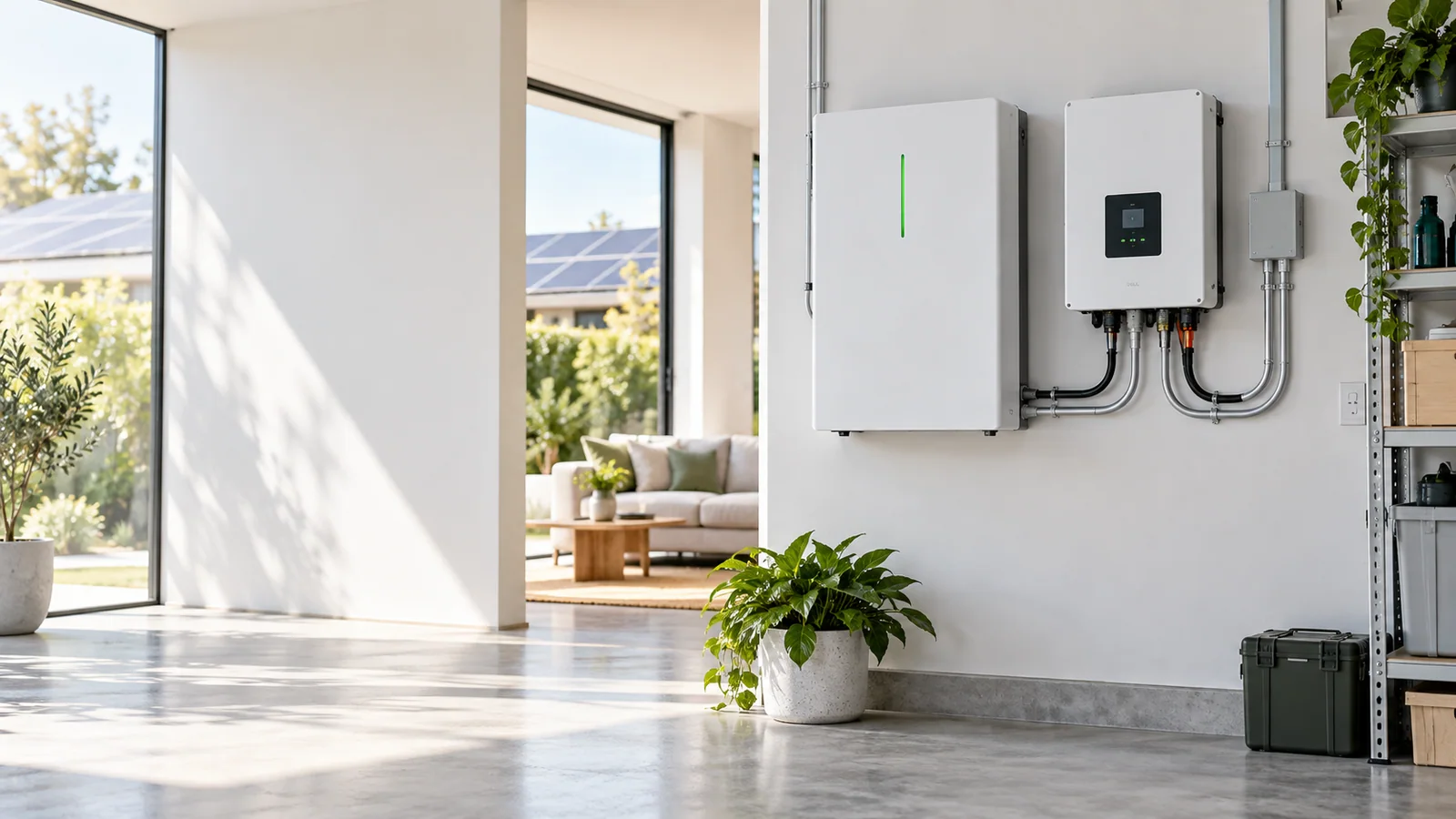
What Does Solar Battery Lifespan Actually Mean?
When people ask how long a solar battery lasts, they may mean two different things: how long the battery can still operate, or how long it can meet the original energy requirement. A battery may continue charging and discharging after its usable capacity has declined, yet provide much less backup time for essential household loads.
A complete cycle-life statement normally connects a cycle count with test conditions and an end-of-life capacity threshold. A large number without the depth of discharge, temperature, charge rate, and retained-capacity condition is not enough for a meaningful comparison. Always compare the full test definition rather than the headline number.
Cycle Life vs. Calendar Life
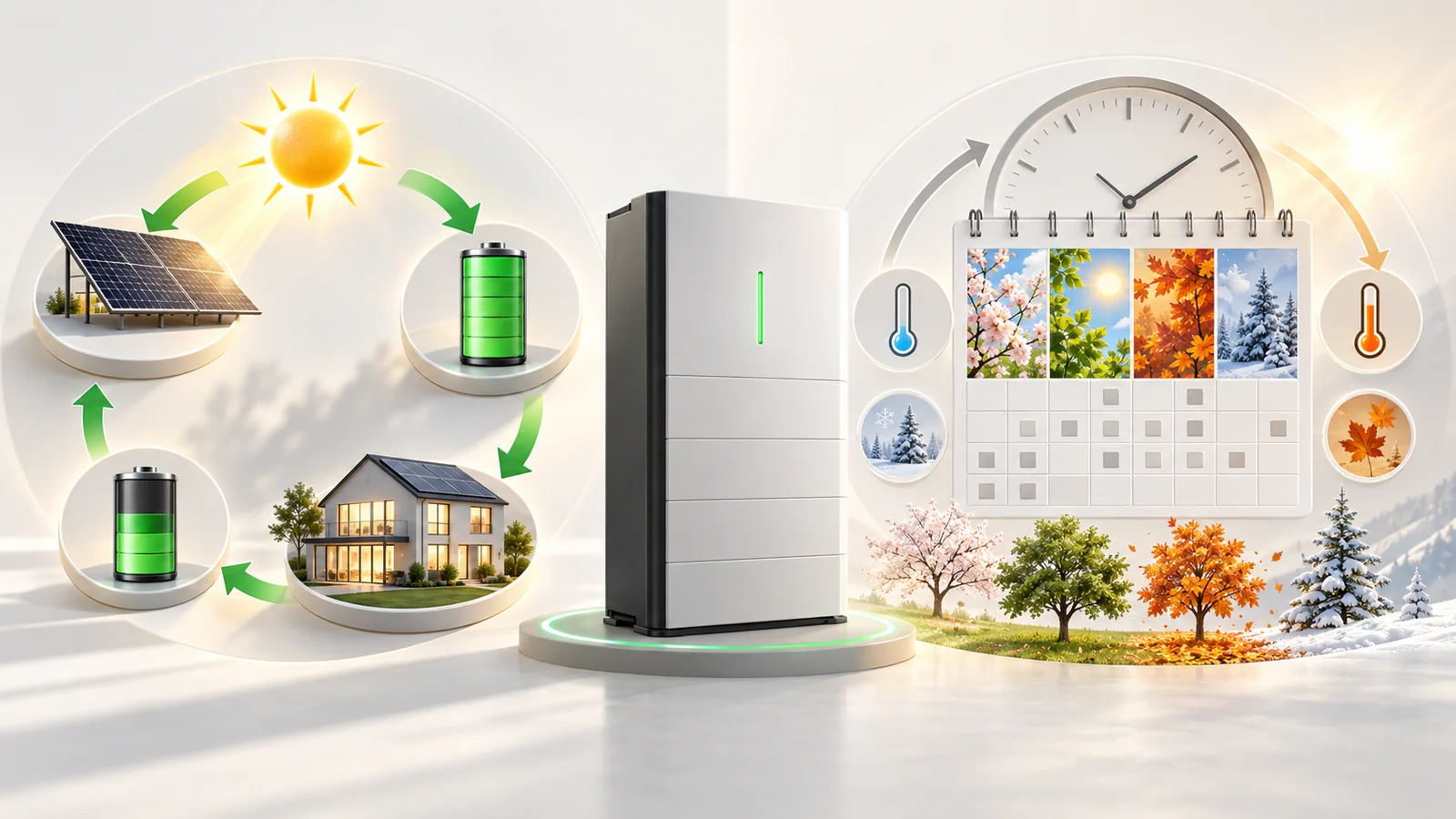
Cycle life describes capacity loss caused by accumulated charging and discharging. One full cycle may be a single deep discharge, or it may be assembled from several shallower discharges. Using a battery every day therefore does not automatically mean that it completes one equivalent full cycle every day.
Calendar life describes aging that continues with time, even when the battery performs little work. Prolonged exposure to heat, a very high state of charge, or an excessively low state of charge can increase aging pressure. A low-use backup battery still needs appropriate storage settings and periodic checks.
- Cycle aging is influenced by cumulative energy throughput, depth of discharge, and charge or discharge rate.
- Calendar aging is influenced by time, temperature, and the state of charge during long storage periods.
- Real service life ends when aging prevents the battery from meeting the project's capacity, power, reliability, or safety requirement.
How Do Different Solar Battery Types Compare?
Battery chemistries should not be ranked only by a claimed number of years. Lithium iron phosphate (LiFePO₄) is widely used in stationary storage because it is well suited to repeated cycling and is valued for thermal stability. Nickel manganese cobalt (NMC) can be useful where energy density matters, while lead-acid may still fit low-frequency, budget-led backup applications.
| Battery type | What to check | Common strength | Main limitation | Typical direction |
|---|---|---|---|---|
| LiFePO₄ | Test cycles, retained capacity, temperature | Well suited to frequent cycling | Still requires correct charging, communication, and thermal conditions | Residential solar and daily energy storage |
| NMC | Temperature, C-rate, depth of discharge | Higher energy density | More sensitive to operating window and thermal management | Space-constrained applications |
| Lead-acid | Depth of discharge, complete charging, maintenance | Lower initial cost in some markets | More limited usable depth and cycle performance | Low-frequency or budget-led backup |
Seven Factors That Affect the Lifespan of Lithium Ion Solar Batteries

1. Cell Chemistry and Manufacturing Consistency
“Lithium-ion” covers several chemistries with different energy-density, thermal, and aging characteristics. Even within one chemistry, cell consistency, assembly quality, electrical protection, and pack design can affect how well a battery remains balanced. Review the complete product documentation instead of assuming that every lithium battery behaves the same way.
2. Temperature and Ventilation
High temperatures can accelerate unwanted reactions inside a lithium-ion cell and produce irreversible capacity loss. Low temperatures can reduce charge acceptance, causing some BMS designs to limit current or stop charging. The installation location must follow the permitted temperature and ventilation conditions for the selected model.
3. Depth of Discharge
Depth of discharge describes how much of the battery's capacity is used in one operating interval. Repeatedly pushing a battery close to its low-state-of-charge limit generally creates more cycling stress. A better design sets usable capacity and reserve energy around the backup objective instead of trying to empty all nameplate capacity every day.
4. Charge and Discharge Rate
Air conditioners, pumps, refrigeration, and motor loads can create substantial power demand. High current increases heat and cell stress, so battery energy capacity, permitted current, and inverter power must be assessed together. A battery with enough kilowatt-hours may still be unsuitable if it cannot support the required kilowatts.
5. State of Charge During Long Storage
Leaving a battery unused at a very high state of charge—or allowing standby loads to keep draining it—can be harmful. The correct storage state depends on the product and its standby consumption. Follow the model-specific manual and establish an inspection or recharge schedule instead of applying one universal percentage.
6. BMS, Inverter, and Charging Settings
The BMS monitors voltage, current, and temperature, but it cannot compensate for an incompatible system. Incorrect charge voltage, current limits, communication settings, or low-state-of-charge protection may cause repeated shutdowns, incomplete charging, or unnecessary battery stress. Compatibility must be confirmed before installation.
7. Installation, Firmware, and Routine Checks
Loose connections, blocked ventilation, unresolved communication alarms, and ignored fault history can weaken long-term reliability. “Low maintenance” does not mean “no inspection.” Periodically review alarms, operating temperature, usable-capacity trends, and communication between the battery and inverter.
How Can You Estimate Service Life in Your Solar System?
Start by identifying the operating duty. A solar self-consumption system may cycle every day, while an emergency-backup system may operate only during outages. The first usually accumulates cycle aging faster; the second still experiences calendar aging, standby consumption, and storage-temperature effects.
Divide average daily discharged energy by usable battery capacity to estimate the daily equivalent-cycle fraction, then account for seasonal variation. Do not simply divide the advertised cycle count by 365. Partial cycles, temperature, changing capacity, charge rate, and calendar aging all affect the result.
Consider a household that charges from solar during the day, uses only part of the stored energy after sunset, and keeps a reserve for outages. It may accumulate only a fraction of a full cycle per day. Another household that repeatedly reaches the battery's low limit will place different aging pressure on the same nominal capacity.
System sizing also changes the outcome. A battery that is too small may cycle deeply and frequently, while a very large battery can spend long periods at a high state of charge if the operating strategy is not planned. Review battery kilowatt-hours, inverter kilowatts, critical loads, and reserve settings together. YINEN POWER's guide to solar-plus-storage system sizing explains why capacity and power should be evaluated as one system.
How to Extend Lithium-Ion Solar Battery Life
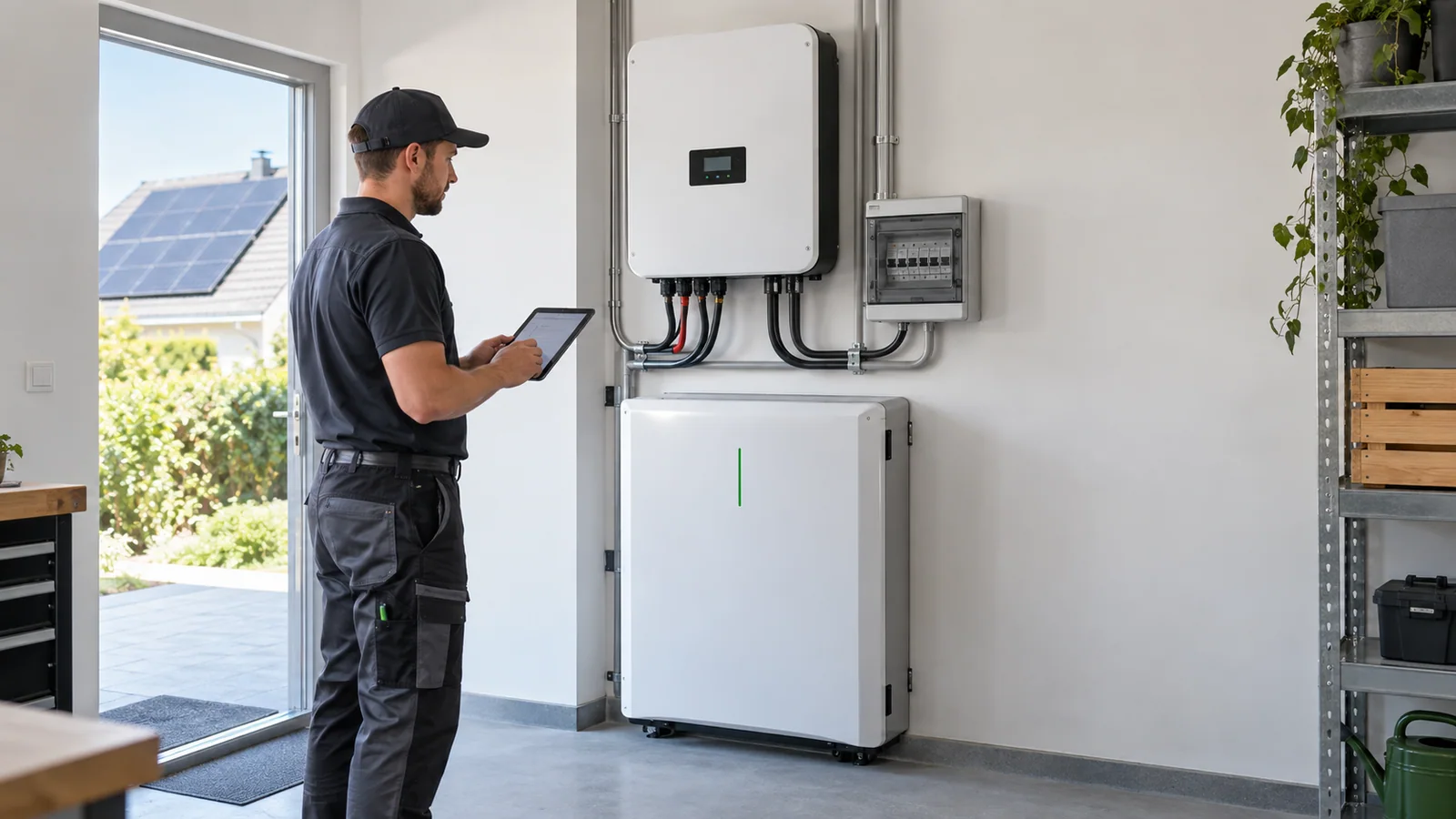
Extending lithium-ion solar battery lifespan does not mean preventing the battery from doing useful work. It means keeping operation inside the design window and avoiding stress that does not contribute to the project goal. Apply the following steps with the model manual, inverter settings, and local installation requirements.
- Keep the battery within its permitted ambient-temperature and ventilation conditions.
- Set a reasonable discharge limit and reserve based on the backup objective.
- Confirm inverter voltage, current, charge profile, and communication settings.
- Avoid prolonged over-discharge and account for standby consumption during shutdown.
- Save alarm records and monitor temperature, runtime, and usable-capacity trends.
- Confirm model, firmware, age, and manufacturer rules before parallel expansion.
- Stop using a battery that develops swelling, leakage, unusual heat, odor, smoke, or physical damage.
What Are the Signs That a Solar Battery Is Near End of Life?
The clearest sign is a consistent reduction in runtime when the load and operating strategy have not changed. Other indicators include charging or discharging ending earlier than expected, sudden state-of-charge jumps, repeated protection events, unusually rapid self-discharge, or operating temperatures that differ from the battery's previous pattern.
A single alarm does not prove that the cells have reached end of life. Inverter settings, cables, protective devices, communication, and ambient temperature can create similar symptoms. Save the error codes and operating records, then have the complete system checked instead of opening the pack, bypassing the BMS, or force-charging it. See YINEN POWER's guide on how to revive a lithium-ion battery safely for a safety-first diagnostic sequence.
What Should You Check Before Buying a Long-Life Solar Battery?
If you want to compare lithium-ion solar battery lifespan, ask the supplier to explain the test conditions behind the cycle claim. Product documentation should also identify usable capacity, retained-capacity threshold, allowed temperature, maximum current, communication method, expansion limits, and the conditions that apply to the warranty.
- Cell chemistry and nominal system voltage
- Depth of discharge, C-rate, and temperature used for cycle testing
- Retained-capacity threshold at the stated cycle count
- Continuous and peak charge or discharge limits
- CAN, RS485, or other communication compatibility
- Indoor or outdoor installation, ventilation, protection, and fire-safety requirements
- Parallel expansion, firmware, documentation, and after-sales rules
A complete home battery energy storage system combines the battery pack with a BMS, inverter, protection, and control functions. YINEN POWER offers residential LiFePO₄ battery, hybrid inverter, and integrated-system directions, but final product selection must follow the actual load, backup duration, solar production, installation conditions, and destination-market requirements.
Share your load, backup-time target, solar capacity and installation conditions with YINEN POWER.
Frequently Asked Questions
Do lithium-ion solar batteries always last 10 years?
No. Ten years is a planning reference for some products and applications, not an unconditional promise. Chemistry, temperature, cycle frequency, depth of discharge, system settings, and test conditions all influence service life. Read the selected model's datasheet and warranty terms.
Is LiFePO₄ better for daily solar cycling?
LiFePO₄ is widely selected for stationary solar storage because it is suitable for repeated cycling and valued for thermal stability. Real performance still depends on cell quality, BMS strategy, temperature, depth of discharge, charging settings, and complete-system design.
Does charging to 100% reduce battery life?
Prolonged operation at a high state of charge can increase aging pressure in some lithium-ion chemistries, but control strategies vary. Do not change charge limits without checking the product manual and warranty conditions or consulting a qualified system provider.
Must the battery and inverter come from the same manufacturer?
Not always, but voltage range, current limits, communication protocol, charging profile, and protection logic must be compatible. A connector that physically fits is not proof of compatibility. Obtain an approved compatibility statement or written supplier confirmation before selection.
Can an aging solar battery continue to operate?
Capacity loss does not always require immediate retirement, but the battery must still meet the project's load, backup, and safety requirements. Stop using a battery that repeatedly protects, overheats, swells, leaks, or self-discharges rapidly, and arrange professional assessment and compliant recycling.
Plan Battery Life as Part of the Complete Energy System
The lifespan of lithium-ion solar batteries is not determined by one cycle number. Cycle aging, calendar aging, temperature, depth of discharge, power demand, and equipment compatibility work together. A reliable evaluation connects product test conditions with the way the system will actually operate.
If you are planning residential storage, review YINEN POWER's home energy solutions and prepare your location, electricity use, critical loads, target backup time, solar information, and installation conditions. These details support a more useful discussion about battery capacity, inverter power, and system direction.
Send YINEN POWER your project data for a practical battery and inverter direction.