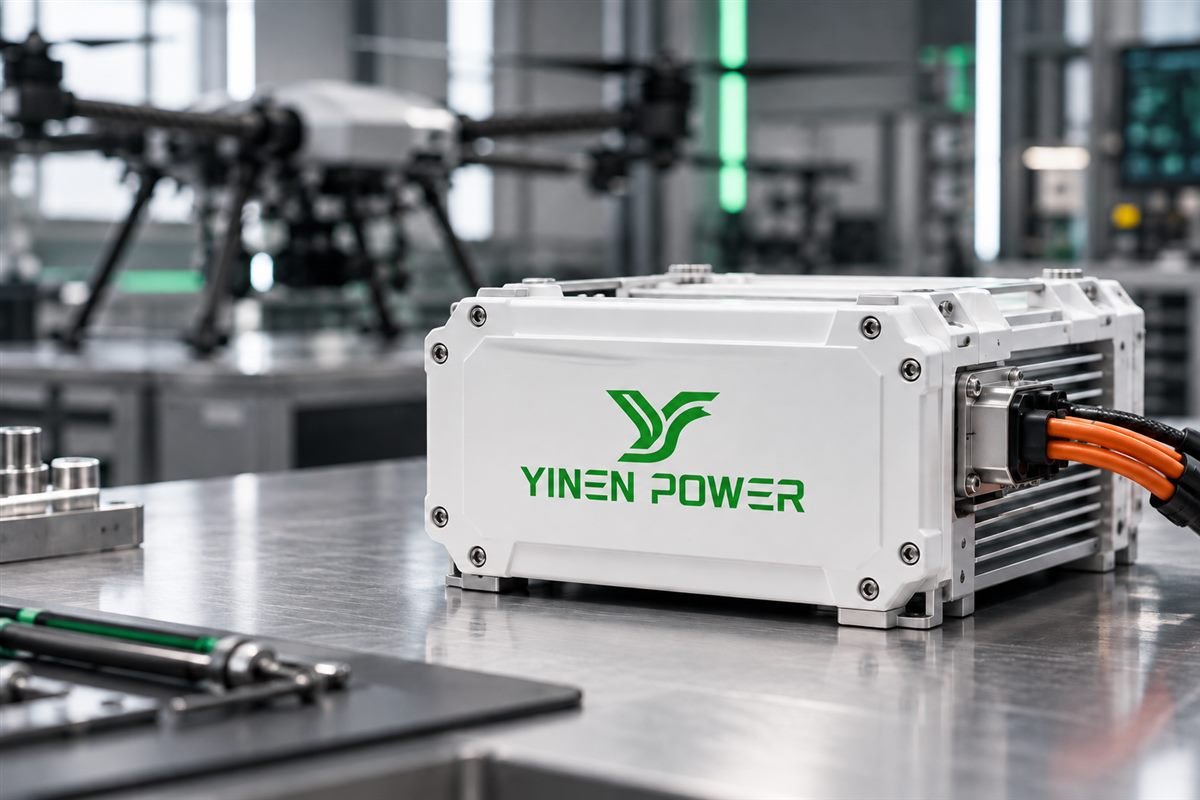
Solid-state and semi-solid battery technology are attracting attention across the industrial UAV sector. But for an engineering team, the right question is not which label sounds more advanced. It is whether a proposed battery can be integrated, validated, supported, and operated safely within the real duty cycle of a specific aircraft.
This guide explains the practical differences behind the terms and gives procurement teams a repeatable way to assess a semi-solid state battery proposal before it enters an industrial UAV project.
What Is a Semi-Solid State Battery?
Conventional lithium-ion cells use a liquid electrolyte. A solid-state battery uses a solid electrolyte architecture, while a semi-solid state battery generally sits between conventional liquid-electrolyte cells and a fully solid-state design. The exact construction varies by supplier, so a marketing term alone is not an engineering specification. The U.S. Department of Energy overview of next-generation batteries also distinguishes solid-state designs by their solid electrolyte approach.
For industrial buyers, ask for a clear description of the cell architecture, pack-level protection strategy, operating limits, charging method, and validation evidence. These details matter far more than a broad technology label.
Why the Difference Matters for Industrial UAV Projects
An aircraft battery is part of a system. Its mass, center of gravity, connectors, BMS behavior, thermal environment, charge workflow, and service process can all affect the final integration. A chemistry change can therefore create work across mechanical design, power electronics, firmware, flight testing, and field operations.
A semi-solid state battery may be presented as a bridge toward next-generation battery technology. That does not remove the need for application-specific validation. A project team should compare proposals against the mission profile rather than infer a result from a product category.
Solid-State vs Semi-Solid: A Project Comparison
| Evaluation area | What to clarify | Why it matters |
|---|---|---|
| Electrolyte architecture | Ask how the supplier defines solid-state or semi-solid for the proposed cell. | Terms are not a substitute for a technical data package. |
| Pack integration | Review enclosure dimensions, mass, mounting, connector type, and center-of-gravity impact. | The pack must fit the aircraft and its operating envelope. |
| Power delivery | Confirm the required load profile, transient behavior, BMS limits, and cable interfaces. | Mission performance depends on the whole power path. |
| Thermal and field use | Define ambient conditions, storage, charging, cooling, and fault handling. | Lab conditions and field conditions are not identical. |
| Readiness evidence | Request test scope, sample status, change control, traceability, and service support. | Evidence supports a more reliable procurement decision. |
What to Validate Before Selecting an Industrial Drone Battery
1. Match the mission profile
Start with the actual duty cycle: payload, launch profile, cruise demand, reserve policy, turnaround expectations, and mission frequency. A battery should be assessed against the power and energy requirements of that profile, not against a single headline claim.
2. Check the mechanical and electrical interfaces
Document pack dimensions, mounting points, service access, connector keying, communication protocol, harness routing, and allowable center-of-gravity range. The proposed solution should be reviewed with both airframe and electrical teams.
3. Review BMS and charging behavior
Confirm what the battery management system monitors, how it communicates status, which fault states it reports, and how charging equipment is controlled. Clarify the response to abnormal temperature, voltage, current, or communication conditions before flight testing.
4. Plan validation in stages
Use a staged process: document review, controlled bench checks, mechanical fit checks, ground power tests, and then defined flight-test gates. Record the configuration of every sample so later results remain traceable when the design changes.
How to Assess Technology Readiness Beyond a Supplier Claim
Technology readiness is not a slogan. Ask what has been demonstrated for the exact cell and pack configuration being quoted. Useful questions include whether the sample is representative of planned production, how revisions are controlled, what testing has been performed, and which parts of the system remain customer responsibility.
Do not compare suppliers using isolated figures alone. Place every technical claim in context: test condition, sample configuration, test method, duration, pass criteria, and the difference between a cell-level result and a pack-level result.
A Practical RFQ Checklist for Semi-Solid Battery Projects
- Mission profile and expected duty cycle
- Target pack envelope, mass limit, mounting method, and center-of-gravity constraints
- Nominal voltage window, power demand, connectors, and communication requirements
- Charging workflow, storage conditions, transport process, and service expectations
- Required engineering documents, test evidence, sample quantity, and change-notification process
- Acceptance criteria and a staged validation plan before fleet deployment
How YINEN POWER Approaches Battery Technology Discussions
YINEN POWER focuses on practical energy-storage conversations: clarify the application, identify the system interfaces, document the operating conditions, and separate verified requirements from assumptions. For projects involving emerging battery technology, we recommend the same disciplined approach: request evidence, define the validation path, and confirm the commercial and technical scope before making an integration commitment.
For stationary energy-storage requirements, our team can help you start a clear discussion around the project profile, energy requirements, installation environment, and system-level considerations.
Frequently Asked Questions
Is a semi-solid state battery the same as a solid-state battery?
No. The terms can describe different electrolyte architectures and development stages. Always request technical documentation for the actual cell and pack offered.
Can a solid-state battery be selected based on a single energy-density claim?
No. The project also needs to validate interfaces, power demand, BMS behavior, thermal conditions, charging, maintainability, and test evidence.
What should an industrial UAV buyer request first?
Begin with the mission profile and the aircraft interfaces. Then ask suppliers to map their proposed battery configuration and evidence package to those requirements.
Need a structured conversation about an energy-storage project? Contact YINEN POWER to discuss your application and system requirements.