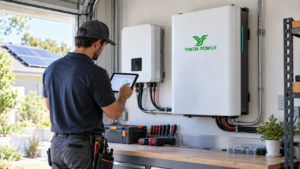
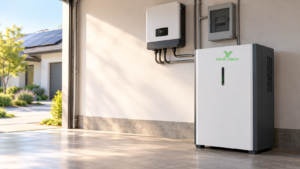
Searching for solar battery manufacturers Germany often leads to brand lists. Lists can be useful for initial research, but they do not establish whether a battery system fits a specific rooftop, electrical interface, operating objective, or installation workflow.
For installers, EPC teams, and commercial buyers, the more useful task is to compare supplier evidence against the project scope. This guide provides a structured way to assess solar battery manufacturers for Germany without relying on broad rankings or unverified claims. A solar battery manufacturers Germany comparison should document the project assumptions behind every supplier response.

\n
Why a “top manufacturer” list is not enough for a German project
A recognized name can be one input, but it does not confirm inverter communication, usable-energy definition, backup sequence, installation constraints, commissioning process, or support responsibilities. A system that fits one retrofit can be unsuitable for a new-build commercial project with export limits or a different control requirement.
Use a shortlist to begin research, then ask every supplier to answer the same technical and commercial questions. This produces a comparison that a project team can review, document, and update when the design changes.
Define the project before comparing solar battery manufacturers Germany
| Project type | Primary question | Evidence to request |
|---|---|---|
| Residential retrofit | Can storage be integrated with the existing PV and electrical arrangement? | Interface diagram, installation requirements, and control scope. |
| New residential PV | What self-consumption, backup, or EV-charging objective is required? | Load profile, inverter strategy, and protected-load definition. |
| Commercial and industrial | Which power, energy, tariff, and export constraints drive value? | Interval data, dispatch concept, and interconnection conditions. |
| Microgrid or resilience project | What must operate during a grid event? | Single-line diagram, critical-load list, and islanding sequence. |
Start by writing the objective in plain language. For example: limit export above a stated threshold, shift solar energy into a specific demand period, or maintain selected loads during an outage. That statement gives suppliers a common basis for sizing and controls.
Check power, usable energy, and expansion separately
Do not compare battery systems using one capacity number alone. Power describes how quickly a system can charge or discharge. Usable energy describes how much energy is available within the selected operating limits. Expansion capability must also be tied to the system architecture and the intended future project stage.
- Ask whether the stated energy figure is nominal or usable for the proposed operating mode.
- Request the selected charge and discharge power alongside the energy figure.
- Ask how additional units, protection equipment, controls, and physical space are treated in an expansion plan.
- Confirm that the proposed configuration matches the load, PV production, and operating duration being modeled.
For projects around the megawatt scale, our battery storage for a 1 MW solar project guide explains why power, usable energy, and dispatch must be reviewed together.
\n
Verify inverter, BMS, and monitoring interfaces
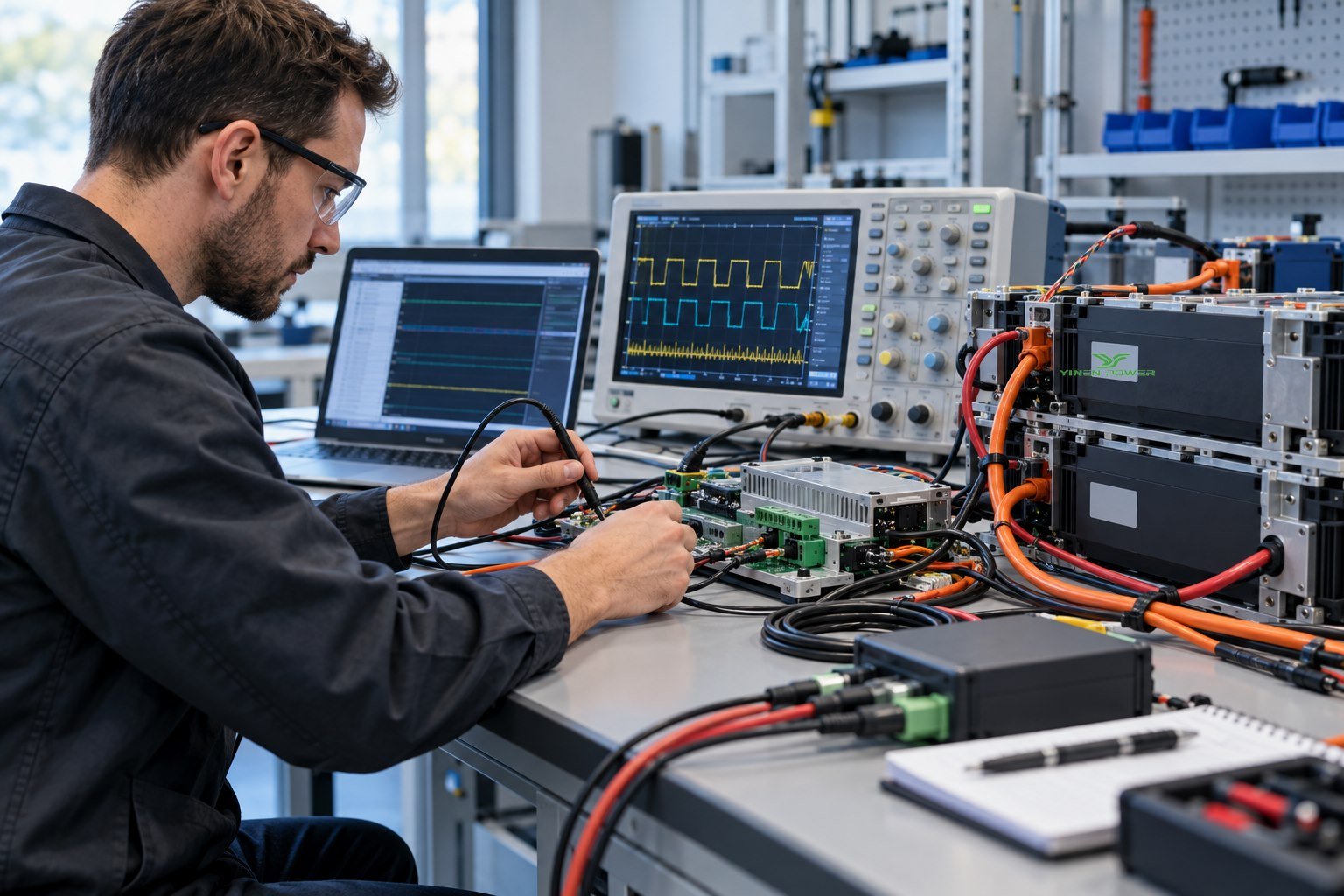
Compatibility is an engineering question, not a logo list. The battery management system, inverter, meter, gateway, and site controller need a defined communication and control arrangement. Request documentation for the proposed equipment combination and identify who will validate it during commissioning.
Clarify the control priorities before order placement. For example, export control, solar charging, peak reduction, and backup reserve can conflict unless the hierarchy is stated. A supplier should be able to show the planned interface and explain what happens when communications are unavailable or a device reports an alarm.
Request project-relevant compliance and installation documents
Requirements vary by equipment, installation environment, connection arrangement, and local project conditions. Instead of treating any certification label as a blanket approval, request the documentation that applies to the proposed configuration and have the responsible project professionals review it. A solar battery manufacturers Germany review should map each document to the exact proposed configuration; project teams can also consult the Bundesnetzagentur for official German energy-market information.
| Document area | Why it matters | Review question |
|---|---|---|
| Product documentation | Defines the equipment supplied and its operating boundaries. | Does it match the exact proposed system? |
| Installation guidance | Addresses placement, clearance, wiring, ventilation, and maintenance access. | Can the site meet every stated requirement? |
| Electrical interfaces | Shows protection, metering, control, and interconnection responsibilities. | Are ownership and commissioning steps clear? |
| Service information | Defines fault reporting, replacement process, and documentation handover. | Who responds and what evidence is required? |

\n
Compare service readiness, not only equipment
A reliable project handover needs more than a delivered cabinet. Ask who supports configuration review, commissioning, operational training, monitoring access, alarm triage, and replacement coordination. Record escalation contacts and the documents required for a support request before the project is energized. When comparing solar battery manufacturers Germany, include the service workflow in the same evidence table as the technical scope.
For a manufacturer-selection framework that applies beyond one market, see our battery energy storage system manufacturer selection steps. It helps turn generic supplier comparisons into a project-specific evidence review.
Use a common supplier-comparison table
Give every shortlisted supplier the same project brief. Then compare responses line by line rather than combining different scopes into one price comparison.
| Comparison item | Supplier response to collect |
|---|---|
| Operating objective | Stated use case, dispatch priorities, and assumptions. |
| System configuration | Power, usable energy, inverter/control equipment, and expansion boundary. |
| Site interface | Single-line concept, metering, protection, and communications scope. |
| Project documents | Equipment data, installation requirements, and commissioning checklist. |
| Support workflow | Commissioning contact, alarm process, and handover responsibilities. |
RFQ checklist for installers and EPC buyers
- State whether the project is a retrofit, new PV installation, commercial site, or resilience application.
- Provide interval load data, PV production information, and the intended operating objective where available.
- Define whether export control, self-consumption, peak management, or backup has first priority.
- Request separate values for power, usable energy, duration assumptions, and control boundaries.
- Request project-relevant documents for the proposed configuration, not generic marketing sheets.
- Ask for a commissioning plan and a clear service escalation path.
Frequently asked questions
Is the best solar battery manufacturer the same for every project in Germany?
No. Project fit depends on the electrical design, operating objective, installation conditions, equipment interfaces, and support model. A repeatable comparison process is more useful than a universal ranking.
What should installers check before selecting a solar battery supplier?
Check the proposed configuration, usable-energy and power basis, control interfaces, installation documentation, commissioning responsibilities, and service workflow against the site requirements.
Can a supplier comparison be used for both residential and C&I storage?
Yes, but the questions must reflect the project. C&I projects typically need additional load, interconnection, dispatch, and electrical-interface evidence.
Build a project-ready supplier shortlist
A useful shortlist of solar battery manufacturers Germany is evidence-led: every supplier should respond to the same operating objective, system scope, interface requirements, and support expectations. YINEN POWER can help project teams discuss solar-plus-storage requirements in a clear, reviewable format.
Talk with YINEN POWER about your residential or commercial solar storage project.